Before the Shared Calendar: How Groups Kept Time
Before the shared calendar, households relied on spoken agreements, remembered routines, and posted notes. Learn how each kept time and where it fell short.
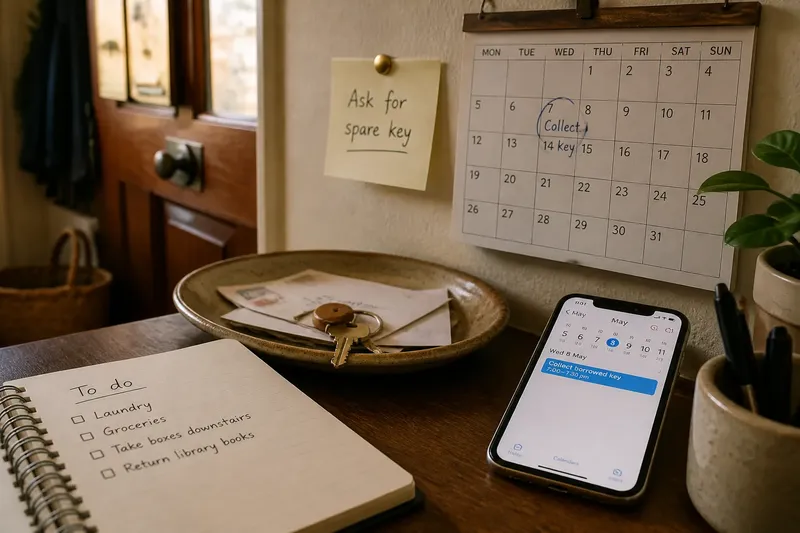
Before a shared calendar, a family might learn that Sunday was laundry day because the wash was already underway, while a housemate might rely on a note beside the telephone to remember a scheduled call. The shared calendar now gives groups another way to keep time, but it sits within a longer history of spoken arrangements, recurring customs, and written notices.
Before calendars, shared time lived in conversation and custom
For much of everyday household life, people coordinated face to face. A parent might tell a child when to come home; neighbors might arrange a visit in conversation; a family might follow a familiar sequence of meals, chores, and errands without writing each one down. Memory was not the only record. Repeated habits supplied their own cues: a meal followed work, a weekly market day shaped shopping, and a familiar bell or clock marked when someone should leave.
These arrangements worked most easily when people shared a place and a routine. They were harder to maintain when a household member was absent, schedules diverged, or an unusual appointment interrupted the usual pattern. A spoken promise could be changed in the moment, but someone who missed the conversation might not know that it had changed.
The distinction matters: older ways of keeping time were not simply less precise versions of a calendar. They tied plans to people, places, and repeated events. A household calendar makes a commitment portable and consultable; a custom makes it familiar and continuous.
Paper records made plans available beyond the conversation
Notes, appointment books, wall calendars, and posted notices gave plans a visible form. A message beside a telephone could preserve a caller’s request. A wall calendar could show the date of a visit to someone who had not been present when it was arranged. A paper record did not depend on every person remembering the same exchange.
But paper also had a specific audience and location. A note in one person’s pocket helped its owner, not necessarily the household. A calendar on the kitchen wall could reach people who passed through the room, while someone away from home might never see a new entry. Handwriting, crossed-out dates, and notes left after plans changed could make the record harder to interpret.
Paper tools therefore changed more than memory. They made some plans visible to people who shared a place, while leaving other people outside the record. The question was not only what to write, but where the record would be encountered.
Digital calendars changed access, not the need for agreement
A shared digital calendar can travel with its users. A person can add a medical appointment from a phone, while another household member checks whether the car is available. Event details can include a location, a reminder, or an invitation to the people affected.
That convenience does not settle what belongs there. A calendar is useful for events that reserve time or affect other people’s plans. It is less suited to every open-ended chore, question, and household intention. If a group treats each passing thought as a calendar commitment, fixed events become harder to distinguish from tasks that can move.
Nor does an entry alone establish responsibility. “Take boxes downstairs” might be a reminder, a request, or a confirmed assignment. The group still needs to make the meaning clear, and to tell the relevant people when a change affects what they should do.
Choose a record that suits the kind of time involved
Households can combine customs, conversation, paper, and digital tools rather than asking one method to serve every purpose. A recurring routine can handle familiar work; a brief conversation can settle an immediate change; a list can hold open tasks; a calendar can reserve time that others need to see.
- Check whether a plan is a fixed appointment. If it reserves someone’s time, enter it on a calendar; if it is a flexible task, keep it on a list or agree on a routine.
- Check who needs to know. If someone is absent or away from the usual meeting place, send the plan in a shared digital record or directly to that person; otherwise, a spoken agreement may be enough.
- Check whether the timing depends on a recurring custom. If the routine is familiar and still works for everyone, keep it as a household habit; if exceptions are easy to miss, record the changed date or time.
- Check whether a paper note will reach its audience. If everyone who needs it passes the chosen spot, post it there; if not, use a record they can access elsewhere.
- Check whether the entry assigns responsibility or only names a task. If one person has agreed to act, name that person; if no one has agreed, ask before treating the item as assigned.
- Check whether a plan has changed. If other people rely on the old time or place, update the shared record and tell them; if no one else is affected, correct the record they use.
What do people ask about keeping household time?
How did households coordinate before shared calendars?
They relied on conversation, memory, recurring customs, clocks, and written notes or appointment books. Those methods could work well for people sharing a routine, but an absent person might not hear a changed plan.
What is the difference between a household routine and a calendar event?
A routine is a repeated pattern people come to expect, such as setting the table before dinner. A calendar event marks a particular commitment or exception that needs a date, time, or shared resource.
Should every household plan go on a shared calendar?
No. Use it for commitments that constrain time or affect others, and keep flexible tasks in a list or familiar routine. The useful distinction is whether another person needs to know when the event happens.
How should a household handle a changed plan?
Update the record people rely on and tell anyone whose next action depends on the change. A correction that remains only in one person’s memory leaves the rest of the group working from outdated information.
A household can see the difference in one changed appointment
Say two housemates have a shared digital calendar, a paper note by the door, and an established habit of sorting mail after dinner. For this invented situation, imagine the calendar shows a Tuesday evening appointment to collect a borrowed key, and the note says to ask for a spare. When the appointment moves to Wednesday, the person who received the change edits the calendar entry, tells the other housemate, and leaves the note in place because the question about a spare still applies. The result is clear: the time changes in the record both housemates consult, while the separate question remains visible without being mistaken for a scheduled event.
Before the shared calendar, households kept time through routines, conversation, and records placed where people could find them. Those forms still matter because no calendar can decide which plans deserve a fixed place, who has agreed to act, or who needs to hear about a change. A short conversation can answer those questions before any tool records the result.