The Keepsake Box Is Not a Memory Test
A keepsake box can hold a few meaningful objects without turning every gift into an obligation, with simple ways to choose, label, and revisit what matters.
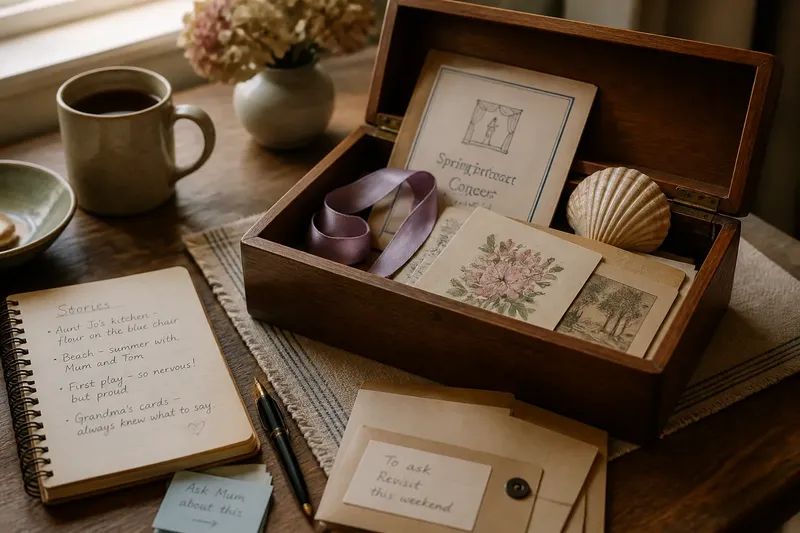
You open the keepsake box and find a school program, a cracked shell, three greeting cards, and a ribbon you no longer recognize. A keepsake box is not a memory test: you do not have to retain every object to show that an occasion, a person, or a season mattered.
Sentiment can live in a handful of objects chosen for the stories they bring back. Make room for the decision at a pace that suits your household, rather than demanding a verdict in one emotional afternoon. The aim is not a tidier box at any cost. It is a collection that feels like yours.
Start with the story, not the object
Before sorting, set the box on a clear table and gather only the things already stored with it. Bring a notebook, a pen, scrap paper for temporary labels, and a small bag or folder for items that need another person’s attention. You do not need to empty drawers or search the whole house; that can turn a modest choice into a larger household project.
Pick up each object long enough to ask what it calls to mind. The answer might be a person, a place, a change in your life, or a small scene you can still picture. If the answer is only “I should keep this,” notice that distinction. Obligation is a real feeling, but it is not the same as a memory you want to revisit.
Write a few words beside the objects whose stories come readily. “Aunt Jo’s kitchen, flour on the blue chair” may tell you more than “recipe card.” A note is not required for every item; it is a way to notice which objects carry a story that might otherwise be easy to lose.
Sort in short passes at a pace that fits
Rather than assigning a task to every day, make a few short passes whenever there is room. You might gather and label items in one sitting, then return to the uncertain pieces after a conversation or a night’s sleep. If you share the box, agree on a time when everyone who has a claim to its contents can take part. One person should not quietly decide the fate of another person’s belongings.
Use these possible passes in any order that makes sense. You can stop after one, combine several, or leave the box as it is until you are ready to continue.
- Gather: Bring together the contents of the keepsake box and clear a place to sort. Keep documents that may be needed for practical reasons separate from objects kept for sentiment.
- Notice: Handle items without making final decisions. Write down the memories that arrive, and mark anything you want to ask someone about.
- Choose strong stories: Set aside pieces that bring back a vivid or meaningful scene. Consider what each object adds, not just whether it is old or attractive.
- Pause on uncertain items: Put them in a temporary folder or separate tray. Choose a time to revisit them so “maybe” does not spread across the whole box.
- Consult others: Ask the people connected to disputed or shared objects what they would like. Give them time to answer; silence in the moment need not be a decision.
- Arrange what remains: Return selected items to the box, add short notes where useful, and move anything promised to someone else into a clearly marked place.
- Check how it feels: Look at what remains and ask whether the box is understandable to you. The goal is a thoughtful selection, not an empty container or a perfectly resolved past.
If life is busy, leave the box alone between passes or spread them out over a longer stretch. The point is to leave some space between noticing an object and deciding what to do with it, not to follow a calendar.
Choose by the memory an object can carry
Some keepsakes serve as compact records. A handwritten recipe may recall not only a relative but also the way a family gathered around a table. A ticket stub can stand for an afternoon with a friend. A child’s drawing may preserve a particular joke or phase of imagination. The object’s value is personal; it does not need to look impressive to anyone else.
It can help to ask whether two items hold the same part of a story. If several cards all remind you of one celebration, perhaps one card in a familiar hand carries enough of that memory. If they represent different relationships or messages, keeping more may make sense. This is not a rule about how many objects belong in a box. It is a way to see whether each one adds something distinct for you.
Imagine you have a stack of school programs from a child’s performances, plus one program with a handwritten note from the child about a funny moment after the show. You set the annotated program aside, compare its specific memory with what the printed schedules bring back, and decide that the note carries the chapter clearly enough. You keep that program and release the others, while recognizing that the other evenings mattered too.
Photographs and written notes can sometimes preserve a detail without keeping a bulky object. A clear photo of a handmade costume, paired with a sentence about who wore it and why it mattered, may be enough for you. But a photograph is not automatically a better keepsake. If the object’s texture, handwriting, or visible wear is part of the memory, the original may be what you want.
What can help when an object is uncertain?
When should I revisit an uncertain item?
Choose a time that feels manageable, such as the next quiet weekend or seasonal sort. Give the temporary group a clear place so it does not become an unmarked second collection.
What if a keepsake belonged to someone else?
Pause before deciding for the person who owns it or has a strong connection to it. If that person cannot take part, keep the item safely aside while you seek their preference rather than treating delay as permission to discard it.
Can a photograph replace the original?
It can when the image preserves the detail you care about and the original itself does not add much. Keep the physical piece when its material, writing, or handling is part of the story you want to revisit.
What if a relative expects me to keep every gift?
You can appreciate the relationship without promising permanent storage for every gift. If useful, explain that you are choosing a few things that bring the memories back clearly, and speak about the person or occasion rather than criticizing the object.
Make the box readable to your future self
Once you have chosen, arrange items so they are easy to recognize. Place delicate paper between sheets of acid-free tissue or in archival sleeves if suitable materials are available. Use a pencil on an appropriate paper note rather than writing directly on an old photograph or document. For fragile, valuable, or historically important pieces, seek advice from a conservator; ordinary household handling may not be suitable. Follow relevant labels and manufacturer guidance for storage materials.
Add brief notes that answer questions a future version of you may have: who is in the photograph, where the object came from, or what happened just before the picture was taken. Keep notes factual and specific. “Dad’s first garden” gives a useful clue; “best day ever” may not tell you which day you meant.
Let the box stay selective. If another meaningful item appears later, ask what story the collection now holds and whether the newcomer adds a different one. There is no need to treat the box as a permanent ranking of loved ones or occasions.
Let care exist without keeping every object
Letting an item go does not erase the memory attached to it. You might pass a keepsake to someone who wants it, recycle or donate an ordinary object where appropriate, or discard something that has no useful next home. If the choice feels raw, waiting is reasonable; postponing indefinitely is also a choice, but it should be deliberate rather than hidden inside a growing pile.
The keepsake box works best as a place you can open without facing a test of whether you remembered enough or cared enough. A few well-chosen objects, with notes that give their stories back, can make the past easier to visit. When you add something new, ask what memory it carries for you. That question is a kinder guide than asking whether you have kept everything.